
China Intensifies Crackdown on VPNs and Foreign Site Access, Raising Concerns Among Netizens
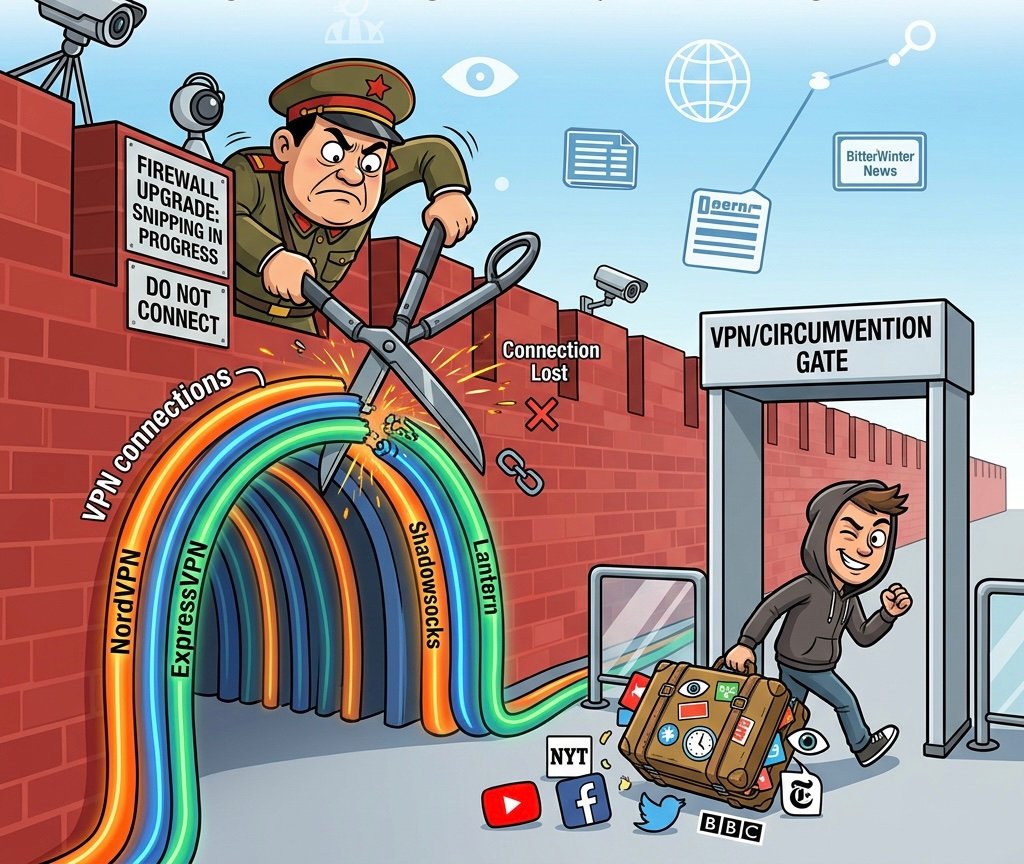
Structured Editorial Report
This report is based on coverage from Bitterwinter.org and has been structured for clarity, context, and depth.
Key Points
- Chinese authorities are reportedly escalating efforts to restrict internet users' access to foreign websites.
- The crackdown primarily targets Virtual Private Networks (VPNs) and similar services known as “airports.”
- This intensified enforcement is causing significant apprehension among Chinese netizens who bypass the Great Firewall.
- Concerns are rising over potential legal penalties for individuals, including fines and administrative punishments.
- The government views these measures as necessary for national security and maintaining social order.
- Critics argue the restrictions violate information rights and aim to further isolate China's digital space.
Introduction
Chinese authorities are significantly intensifying their efforts to restrict domestic internet users' access to foreign websites, primarily by targeting Virtual Private Networks (VPNs) and similar circumvention tools often referred to as "airports." This escalating crackdown has generated considerable apprehension among Chinese netizens who rely on these services to bypass the sophisticated internet censorship system known as the Great Firewall. The government's actions underscore a strategic imperative to maintain stringent control over information flow and prevent access to content deemed undesirable, politically sensitive, or contrary to state narratives. This development signals a potential shift towards a more isolated digital environment within China, raising concerns about the future of information access and digital freedoms for its citizens.
Key Facts
* **Targeted Services:** The crackdown specifically targets Virtual Private Networks (VPNs) and "airports," which are proxy services designed to circumvent internet restrictions.
* **Government Rationale:** Chinese authorities frame these measures as essential for national security, maintaining social stability, and preventing the spread of misinformation or foreign influence.
* **Technical Escalation:** Reports indicate enhanced technical capabilities by the Great Firewall to detect and block encrypted VPN traffic and associated IP addresses, leading to increased instability and disruption for users.
* **Legal Ramifications:** There is a growing concern among users regarding the legal consequences of using VPNs, with reports of stricter enforcement, including warnings, fines, and potential administrative punishments.
* **Economic Impact:** Businesses, academics, and researchers who depend on VPNs for international communication and access to global resources face significant operational challenges and potential economic disadvantages.
* **Information Control:** The intensified crackdown is part of a broader strategy to further consolidate the government's control over the digital information landscape within China, limiting exposure to external perspectives.
* **User Response:** Chinese netizens are actively discussing alternative circumvention methods and expressing anxieties about the diminishing avenues for accessing uncensored information.
Why This Matters
This intensified crackdown on VPNs and foreign site access in China carries profound implications for a wide array of stakeholders, extending far beyond individual internet users. For Chinese citizens, it represents a significant erosion of their ability to access diverse information, engage with global perspectives, and participate in international online communities. This directly impacts academic research, professional development, and personal freedoms, potentially fostering a more insular digital experience.
Businesses operating within China, both domestic and international, face substantial operational hurdles. Many rely on VPNs for secure communication with overseas offices, access to global cloud services, international market research, and collaboration with foreign partners. Disruptions to these essential tools can lead to decreased efficiency, increased operational costs, and a competitive disadvantage. Foreign companies, in particular, may find it harder to integrate their Chinese operations with global strategies, potentially impacting investment decisions and market access.
Academics, scientists, and researchers are particularly vulnerable. Access to international journals, databases, collaborative platforms, and uncensored information is critical for scientific advancement and intellectual exchange. The tightening restrictions threaten to isolate Chinese academia from global research trends and limit their contributions to the international scientific community.
Furthermore, this development has broader geopolitical implications. It underscores China's commitment to a sovereign internet model, distinct from the global open internet. This approach could influence other authoritarian regimes and contribute to a more fragmented global digital landscape, challenging principles of internet freedom and open information exchange worldwide. The economic and social ramifications of a more digitally isolated China could be substantial, affecting innovation, international trade, and cultural exchange.
Full Report
Chinese authorities have reportedly escalated their long-standing campaign against unauthorized internet access, with a renewed and more aggressive focus on Virtual Private Networks (VPNs) and similar circumvention technologies. This intensification is manifesting through advanced technical blocking measures and a more stringent enforcement of existing regulations, creating a climate of uncertainty and apprehension among millions of Chinese internet users.
The core of this crackdown targets services that allow users to bypass the Great Firewall, China's sophisticated internet censorship apparatus. While VPNs have historically provided a crucial conduit for accessing global information, reports from within China indicate that their reliability and accessibility are rapidly diminishing. Users across various platforms, including social media and private forums, have reported increased difficulty in establishing and maintaining stable connections to their preferred VPN services. This suggests that the Great Firewall's technical capabilities have been upgraded to more effectively detect and block encrypted traffic, as well as identify and blacklist IP addresses associated with VPN servers.
Beyond technical blocking, the legal framework surrounding VPN use appears to be hardening. While the provision of unauthorized VPN services has long been illegal in China, the individual use of VPNs for personal access has often existed in a legal grey area. However, recent reports suggest a shift towards stricter penalties for individual users. There are accounts of local authorities issuing warnings, levying fines, and in some cases, imposing more severe administrative punishments on individuals found to be circumventing the Great Firewall. This move indicates a broader strategy to deter not only the providers but also the end-users of these services.
The government's stated rationale for these measures consistently revolves around national security, maintaining social order, and preventing the spread of what it deems misinformation or foreign influence. State media narratives frequently portray unauthorized internet access as a threat to stability and a conduit for undesirable content. This perspective frames the crackdown as a necessary defense mechanism against external threats and internal dissent.
For businesses, both domestic and international, the implications are significant. Many companies rely on VPNs for secure internal communications, access to global cloud infrastructure, and engagement with international clients and partners. The disruption of these services can severely impede operations, increase cybersecurity risks if less secure alternatives are sought, and hinder global competitiveness. Academics and researchers also face substantial challenges, as access to international scholarly databases, collaborative platforms, and uncensored research materials is crucial for their work.
The current escalation is not an isolated event but rather part of a continuous effort by the Chinese government to tighten its grip on the digital sphere. It aligns with a broader trend of enhanced digital surveillance, real-name registration requirements for online services, and increased scrutiny of online content. The long-term trajectory appears to be towards a more controlled and isolated digital ecosystem within China, raising fundamental questions about information freedom and the future of internet connectivity in the country.
Context & Background
The concept of a "sovereign internet" has been a cornerstone of China's digital policy for decades, culminating in the development and continuous evolution of the Great Firewall. Initiated in the late 1990s, this sophisticated system of internet censorship and surveillance has grown into one of the world's most advanced and comprehensive filtering mechanisms. Its primary purpose is to filter and block foreign websites, social media platforms, news outlets, and any online content that the Chinese Communist Party (CCP) deems a threat to national security, social stability, or its ideological narrative.
Historically, the Great Firewall has employed various techniques, including IP blocking, DNS poisoning, URL filtering, and deep packet inspection. Despite these controls, VPNs and proxy services emerged as the primary means for millions of Chinese citizens to circumvent these restrictions. For years, the use of VPNs, while technically unauthorized, often existed in a grey area, with authorities periodically cracking down on providers but generally tolerating individual users, especially those with legitimate business or academic needs.
Previous crackdowns on VPNs have occurred in waves, often coinciding with politically sensitive events or periods of heightened government control. These earlier efforts typically led to temporary disruptions, the closure of some service providers, and a cat-and-mouse game where new VPNs would emerge to replace those that were blocked. However, the current reports suggest a more systematic, technically advanced, and potentially punitive approach.
This intensified crackdown aligns with a broader trend under the current administration to consolidate control across all sectors of society, including the digital realm. Recent years have seen the introduction of stricter cybersecurity laws, real-name registration for virtually all online services, and increased surveillance capabilities. The government has also promoted domestic alternatives to foreign technology and platforms, further reinforcing its vision of a self-reliant and controlled digital ecosystem. The current actions against VPNs can be seen as a critical step in closing the remaining significant loopholes in the Great Firewall, moving China closer to a fully controlled and isolated national internet.
What to Watch Next
The ongoing crackdown on VPNs in China presents several critical developments to monitor in the coming months.
Firstly, observe the **technical evolution of the Great Firewall**. Will authorities continue to enhance their detection and blocking capabilities, making existing VPNs increasingly unreliable? The emergence of new, more resilient circumvention technologies, or the adaptation of existing ones, will be a key indicator of the ongoing technological arms race between censors and users. Pay attention to reports from cybersecurity firms and user communities regarding the effectiveness of various VPN protocols and services.
Secondly, monitor the **legal and enforcement landscape**. Will the reported stricter penalties for individual VPN users become widespread and systematically enforced across different regions? The number of reported fines, administrative detentions, or other punishments will indicate the government's resolve to deter personal VPN use. Any official statements or new regulations clarifying the legal status of VPN use will also be crucial.
Thirdly, assess the **impact on businesses and academic institutions**. Look for public statements from foreign chambers of commerce or industry groups detailing the operational challenges faced by their members. Reports on changes in foreign direct investment or the relocation of certain business functions due to connectivity issues could signal significant economic repercussions. Similarly, observe any shifts in international academic collaborations or the accessibility of research materials for Chinese scholars.
Fourthly, watch for **changes in online information consumption patterns** within China. Will the reduced access to foreign information lead to a greater reliance on state-controlled media and domestic platforms? Any visible shifts in public discourse, the prevalence of certain narratives, or the decline in engagement with
Found this story useful? Share it:
Sources (1)
Bitterwinter.org
"Bitter Winter – China: Fears of a Further Crackdown on Netizens Illegally Accessing Foreign Sites"
April 17, 2026